
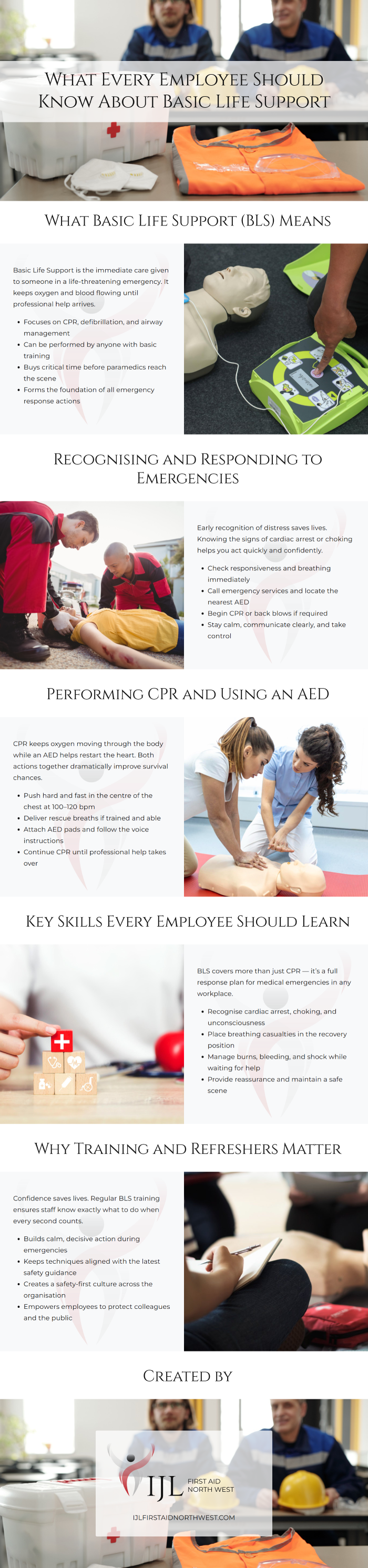
In every workplace, from offices to construction sites, the potential for a medical emergency is always present. Whether it’s a sudden cardiac arrest, choking incident, or collapse from illness, knowing how to respond calmly and effectively could be the difference between life and death. That’s where Basic Life Support (BLS) training comes in — a vital skill set that empowers ordinary people to take extraordinary action.
Basic Life Support isn’t limited to healthcare workers; it’s a universal skill that gives employees the ability to preserve life before professional help arrives. In this post, we’ll explore what BLS involves, why it’s so important, and what every employee should understand about their role in a life-saving situation.
Understanding Basic Life Support
Basic Life Support is the foundation of emergency care. It refers to the immediate actions taken to sustain life in someone who has stopped breathing, whose heart has stopped, or who is otherwise unresponsive. BLS is designed to keep oxygen and blood flowing through the body until advanced medical assistance becomes available.
- Involves core techniques like CPR and AED use to maintain vital functions
- Focuses on rapid recognition and prompt action in emergencies
- Can be performed by anyone with the right training — not just medical staff
- Provides the essential link between collapse and professional care
Why Basic Life Support Matters in Every Workplace
Emergencies don’t just happen in hospitals. They can occur in offices, factories, retail spaces, schools, or warehouses — anywhere people gather. When staff know how to deliver Basic Life Support, it creates a safer environment and greatly improves survival chances.
- Enables immediate response before paramedics arrive
- Reduces the time between collapse and life-saving intervention
- Builds confidence among staff to handle high-pressure situations
- Promotes a proactive safety culture within the workplace
Even in low-risk industries, having trained employees on hand provides reassurance that colleagues, clients, and visitors are protected if the unexpected happens.
Recognising the Signs of Cardiac Arrest
One of the most common and critical situations where BLS is required is cardiac arrest. Recognising it early is vital to ensuring fast, appropriate action. Employees should understand how to identify the key symptoms and react without hesitation.
- Look for unresponsiveness — the person does not move or respond when spoken to
- Check for normal breathing; gasping or irregular breaths are signs of cardiac arrest
- Call emergency services immediately and request an ambulance and AED
- Begin CPR and continue following instructions until help arrives
Quick recognition and intervention can double or even triple survival chances, making awareness as important as the physical skills themselves.
How to Perform CPR Effectively
Cardiopulmonary Resuscitation (CPR) is one of the most powerful tools in BLS. It keeps oxygen circulating through the body, buying precious time until professional medical assistance arrives. Every employee can learn it — and every employee should.
- Place the heel of your hand on the centre of the chest and interlock your fingers
- Push hard and fast at a rate of 100–120 compressions per minute, about 5–6 cm deep
- Allow the chest to fully rise between compressions
- If trained, deliver rescue breaths in a 30:2 ratio (compressions to breaths)
Even hands-only CPR can make a significant difference, so confidence and immediate action are more important than perfection.
The Role of Defibrillation in Basic Life Support
A defibrillator, or Automated External Defibrillator (AED), restores a normal heart rhythm during cardiac arrest. Modern AEDs are designed for public use, guiding the rescuer through every step with clear voice and visual instructions. Knowing where your nearest AED is located could save a life.
- Switch on the AED and follow the voice prompts carefully
- Attach pads to the casualty’s chest as shown on the diagrams
- Ensure no one touches the casualty during rhythm analysis or shock delivery
- Resume CPR immediately after the AED gives instructions
Every minute without defibrillation reduces survival chances by roughly 10%, making quick access to an AED a vital link in the chain of survival.
The Chain of Survival Explained
Basic Life Support fits into a broader concept known as the Chain of Survival — a series of steps that maximise the chances of survival during cardiac arrest. Understanding this sequence helps employees know exactly what to do and when.
- Early recognition and call for help — identifying the emergency quickly
- Early CPR to maintain blood flow and oxygen
- Early defibrillation using an AED
- Post-resuscitation care provided by medical professionals
Each link depends on the other. When all are performed promptly and correctly, survival rates increase dramatically.
Handling Choking Emergencies
Choking can happen at any time, whether during lunch breaks, meetings, or workplace events. BLS training ensures employees can respond effectively to this frightening and time-critical emergency.
- Encourage the casualty to cough if they can still breathe or speak
- Deliver up to five firm back blows between the shoulder blades if needed
- Follow with up to five abdominal thrusts if the obstruction persists
- Alternate between both until the airway clears or emergency help arrives
Quick and confident action prevents oxygen deprivation and serious complications.
Responding to an Unconscious Casualty
When someone becomes unresponsive but continues breathing, placing them in the recovery position can help maintain their airway and prevent complications. It’s a simple but essential part of Basic Life Support that all employees can master.
- Check responsiveness and breathing before moving the casualty
- Gently roll them onto their side, supporting their head and neck
- Tilt the head back slightly to maintain a clear airway
- Monitor breathing and stay with them until medical help arrives
This position helps prevent choking and keeps the airway open, making it one of the most important actions in first-response care.
The Importance of Staying Calm and Acting Quickly
Emergencies can be stressful and overwhelming, but calm, decisive action saves lives. BLS training not only teaches physical skills but also builds the confidence to overcome panic and focus on what needs to be done.
- Take a deep breath and assess the situation clearly
- Follow the steps you’ve been taught rather than rushing
- Delegate tasks — someone can call emergency services while you provide care
- Remember that doing something is always better than doing nothing
Remaining composed reassures both the casualty and bystanders and ensures that help is delivered efficiently.
Why Every Employee Should Be Trained in BLS
BLS training isn’t just for first aiders — it’s for everyone. In the minutes before professional responders arrive, the actions of ordinary people are often what determine whether someone survives.
- Equips all staff with life-saving knowledge and confidence
- Strengthens workplace safety and preparedness
- Reduces reliance on a single designated First Aider
- Fosters a culture of responsibility and teamwork
When more people in the workplace are trained, emergencies are handled faster, more effectively, and with far greater confidence.
The Benefits of Regular Refresher Training
Even experienced First Aiders can lose confidence if they haven’t practised for a while. Regular refresher training ensures that skills remain sharp and response times stay quick.
- Reinforces correct technique and up-to-date guidance
- Refreshes memory of key procedures under realistic conditions
- Increases speed and accuracy during real-life emergencies
- Builds stronger team awareness and communication
Annual or biannual refreshers keep BLS skills current and maintain compliance with health and safety expectations.
Encouraging a Culture of Safety and Care
BLS training strengthens more than just emergency response skills — it builds a culture of care, teamwork and community within an organisation. When staff know how to protect one another, it fosters mutual trust and responsibility.
- Promotes awareness and respect for health and safety standards
- Encourages cooperation and shared responsibility for wellbeing
- Demonstrates a commitment to employee welfare and resilience
- Creates a supportive environment where everyone feels protected
This culture not only improves safety but also enhances morale and confidence across the workplace.
What Employers Can Do to Support BLS Training
Employers play a vital role in ensuring their teams are trained and confident. Providing access to BLS courses helps fulfil legal obligations while building a safer, more capable workforce.
- Include BLS training in induction or annual training programmes
- Conduct regular drills or awareness sessions
- Display AED locations clearly across the premises
- Encourage open discussion and questions about emergency response procedures
Supporting this training demonstrates genuine commitment to the welfare of employees, customers and visitors alike.
Conclusion: Everyone Can Help Save a Life
Basic Life Support is more than a skill — it’s a responsibility shared by everyone in the workplace. Knowing how to recognise emergencies, perform CPR, use a defibrillator, and provide immediate care can make the difference between tragedy and survival.
When employees understand and practise these techniques, they build confidence, improve safety, and strengthen their organisation’s ability to respond in critical moments. The time spent learning BLS is an investment that lasts a lifetime, ensuring that when the unthinkable happens, someone is ready to step forward and save a life.

5 star reviews

Vocational qualifications

Online video


REVIEWS